
Trellis under £100 - Best Deals in UK!
Showing the single result

Trellis under £100 covers compact garden screens, wall trellis panels, arches and obelisks that add structure, privacy and support for climbers without stretching the budget.
Smart structure, small spend
Choosing a trellis under £100 is less about cutting corners and more about making the right shape work for the space you have. In this price range, you can find plenty of options that do a proper job: guiding climbing plants, breaking up blank fences, softening hard walls and adding a bit of detail where the garden feels flat. The point is not just decoration. A good trellis gives plants a way up, helps corners feel finished and can turn an awkward patch into something that looks thought through.
What makes this category useful is the range. Under £100, trellis can be small and simple or more decorative and statement-led, but it still tends to be practical first. You’ll often see flat panels, fan shapes, arches, obelisks and expandable lattice styles, each suited to a different spot. That matters because a trellis that suits a narrow courtyard won’t always make sense against a long fence line, and a tall support for a climber is a different thing altogether from a screen to hide a bin area.
Panel, fan or arch? The shapes do different jobs
The most common choice in this price bracket is the flat trellis panel. It sits neatly against a fence, wall or shed and is easy to repeat along a boundary. This works well if you want a tidy, linear look, or if you’re trying to make a plain surface feel less severe. Flat panels are often the best choice when the aim is to support climbing roses, clematis, jasmin or other climbers that need something they can latch onto without too much fuss.
Bestseller der Kategorie Trellis under £100
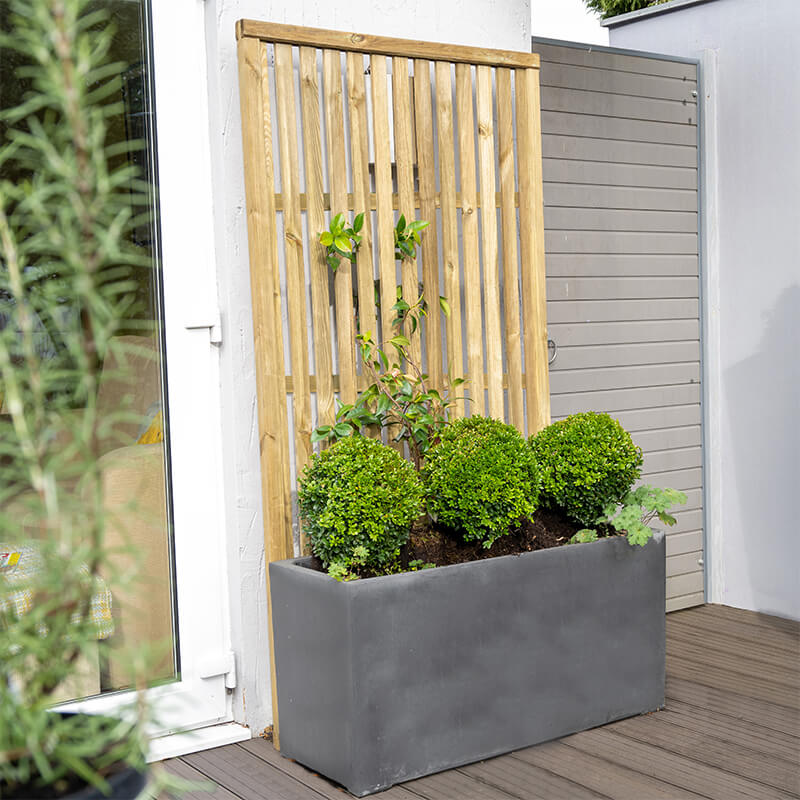
Fan trellis is different. The shape spreads out from a narrower base and gives a more ornamental feel, almost like a soft burst across the wall. It can suit smaller spaces because it looks deliberate even when it covers only a modest area. Fan styles are handy where you want a plant to climb in a more controlled pattern rather than just running straight up. They also look good when used in pairs or in a rhythm across a wall, though even one can make a strong visual point.
Arch trellis sits in another category entirely. It’s less about covering a surface and more about framing a route, entrance or transition. A trellis arch can mark the move from one part of the garden to another, and it works especially well where you want height without building a heavy structure. Under £100, arches tend to be lighter in feel and more compact than larger metal garden arches, but that can be an advantage in smaller plots where a bigger frame would dominate.
Obelisks and tower trellises are best thought of as vertical support rather than wall decoration. They bring height into beds, borders and patio pots, and they’re often chosen for plants that grow upward in a neat column rather than spreading sideways. These are useful when space is tight, because they build interest in the third dimension without taking much ground area. They can also make a mixed border feel more planned, even when the planting is informal.
Materials that make sense on a budget
Within the under-£100 bracket, the material choice usually shapes the look more than the price does. Timber trellis tends to feel traditional and easy to blend into a cottage-style garden, a painted fence or a softer planting scheme. It often has a warmer look than metal, and the lattice pattern can be square, diamond or more decorative depending on the design. Timber suits people who want the trellis to sit quietly behind the planting rather than take over the scene.
Metal trellis, by contrast, often brings a slimmer profile. That can matter if you want something that doesn’t visually bulk out a wall. Metal designs can feel more architectural, and they often suit modern patios, urban gardens or narrow side returns. Some are simple rods or wire-style grids, while others lean into scrolling patterns or curved lines. The difference is not only visual: metal frames can sometimes appear lighter and more open, which is useful when you want climbers to be the main feature and the trellis to stay in the background.
Willow and woven trellis are another option in this price range, especially where a softer, more natural feel is wanted. These can work well as garden screens or low boundary pieces, and they often look less formal than wood or metal. They suit informal planting schemes and can help a new garden settle in visually without making it feel too rigid. The trade-off is that the look is more rustic, so if you want crisp lines and strong symmetry, woven styles may not be the best fit.
Where each trellis type earns its keep
A lot of trellis buying comes down to location. A wall-mounted trellis is good when you already have a surface and just need support or pattern. It makes sense on sheds, garage walls, brick boundaries and fence panels, especially where the planting is meant to climb rather than sprawl. This kind of trellis can also be used to break up long runs of fencing so the garden feels less like a corridor.
Free-standing trellis works differently. It can be positioned where a wall doesn’t exist, or used to divide a seating area from a working area without a full fence. In a border, it can create a little vertical pause, a place where the eye stops before moving on. Free-standing pieces are useful if your layout changes from season to season, because they can be moved or re-used in another part of the garden, depending on the style.
Corner trellis and screen panels are worth noting too. Corners often end up looking dead or neglected, and a shaped trellis can make the most of them. Screening styles are more about privacy and visual blocking, but not in a heavy-handed way. They can hide wheelie bins, compost areas or the view of a neighbour’s utility corner while still letting the space feel airy enough for a small garden.
Why buyers keep coming back to this price band
One of the main reasons people search for trellis under £100 is that it sits in a useful middle ground. It’s enough budget to move beyond basic fixings and get a piece with some visual character, but not so much that the project becomes a big outlay. That makes it appealing for renters with permission, first-time gardeners, people adding structure after a landscaping project, or anyone refreshing a tired wall without starting from scratch.
Another advantage is choice. Within this price point, you’re not locked into one style. You can choose between decorative lattice, simple support grids, garden arches, fan trellis, obelisks and more compact screening formats. The variety means you can match the trellis to the purpose rather than buying the same thing for every space. That can save money in a practical way, because the right shape is more likely to be used properly and kept in place.
There’s also the visual return. A single trellis can make an empty fence feel planted, and a row of them can create a rhythm that makes even a small garden look more considered. If you’re trying to get more from a modest space, this is one of the easier upgrades to understand and one of the easier ones to notice once it’s in place.
Different looks for different gardens
Some trellis styles are meant to disappear behind foliage, while others are part of the display. That difference matters more than people sometimes think. A diamond lattice trellis is a classic choice where the planted growth should do most of the talking. Its pattern is familiar, balanced and easy to place almost anywhere. It suits traditional gardens, boundary work and planting that needs gentle support rather than a strong design statement.
Square-grid trellis can feel cleaner and more contemporary. It often works well in modern schemes where straight lines are already part of the garden language. If your paving, fencing or planters are angular, square grid trellis can tie everything together without shouting about it. It also gives a slightly firmer visual rhythm than diamond lattice, which may suit more architectural planting.
Decorative scroll trellis adds more pattern and can be useful when the trellis is not just a support but a feature in its own right. These styles tend to suit smaller sections, because too much ornament across a long span can feel busy. Used in the right place, though, they bring a sense of detail that a plain grid doesn’t always give. For a cottage garden or a romantic planting scheme, that extra linework can make a difference.
Expandable trellis is worth a mention for awkward gaps. It can be adjusted to fit narrower or wider spaces, which makes it handy for odd corners or temporary layouts. The look is usually more casual than a fixed panel, but the flexibility is the selling point. If the space is slightly off-square, this style can save a lot of measuring and rethinking.
Support, screening and a bit of softness
The value of trellis is not only that it holds plants upright. It also changes how a garden feels at eye level. A bare wall can look hard and unfinished; a trellis with climbers softens that surface and brings in a layered effect. Even before the planting fully fills in, the trellis itself gives a sense of order. That’s useful in winter and early spring too, when the structure of the garden matters as much as the leaf cover.
For privacy, trellis is a lighter alternative to a solid fence panel. It can obscure a view without blocking everything out. That halfway effect is often exactly what people want in smaller gardens: enough screening to feel less exposed, but not so much that the space turns boxed in. It is especially useful above a wall or fence line, where a short section of trellis can lift the boundary without making it seem heavy.
In planting terms, trellis helps climbers use vertical space instead of spreading across the ground. That can be practical in borders where every inch counts. It also allows you to pair strong upright planting with lower plants underneath, which gives the border more layers. The result is often a fuller-looking garden even when the actual footprint stays the same.
Small details worth checking before you buy
When comparing a trellis under £100, the details matter. Look at the overall dimensions first, because height and width can change how a piece works more than the style does. A trellis that seems fine in a photo may feel too narrow once it’s placed against a full fence bay. On the other hand, a piece that looks modest online may be just right for a smaller courtyard or a side return.
Fixing style is another point. Some trellis is designed to mount onto an existing structure, while other styles stand on their own. That changes how it will sit in the garden and how visible it will be once installed. If you want a clean, flush finish, wall-mounted may suit. If you need movement or flexibility, free-standing can be better. Neither is automatically better; it just depends on the job.
Also think about the openings in the lattice. Wider gaps give a more open look and suit larger climbers or a lighter decorative feel. Smaller gaps can create denser coverage and more detail, though they may feel busier if the surrounding garden is already full of texture. The spacing between bars or slats has a bigger effect than many buyers expect.
Finish matters too. A painted or coated metal trellis can blend neatly into a boundary, while natural timber may be left to sit visually against planting and brick. The right finish is usually the one that supports the rest of the garden rather than competing with it. It’s a small point, but small points often decide whether a space feels tied together or a bit random.
Getting the most from a practical buy
If you’re buying trellis for a specific use, it helps to think in pairs: function and form. Do you need support for a plant, a screen for a view, or a detail on a wall that feels too plain? Once that’s clear, the shape usually follows. A climber that grows tall and narrow may be happier on a panel or obelisk, while a plant that spreads gently could suit a fan shape or a wider lattice.
Budget trellis can still feel considered when it matches the setting. A small courtyard might benefit from one striking fan piece rather than several plain panels. A long fence could need repeated sections to build unity. A bed near a patio might call for a slim obelisk that adds height without taking over. These are not big decisions, but they change how the whole garden reads.
If you want a purchase that feels worthwhile, choose a trellis that can do more than one job. A screen can also support planting. A decorative panel can also soften a boundary. An arch can mark a path and give height. That flexibility is part of why this category is so useful: you’re not just buying a shape, you’re adding a usable layer to the garden.
A tidy finish for spaces that need something more
Trellis under £100 is a sensible place to look when a garden needs structure, support or a bit of quiet character. Whether you go for a flat panel, a fan trellis, an arch, an obelisk or a screening design, the right piece can change how a boundary feels and how plants behave in the space. The best choice is usually the one that fits the job first and the style second, though with trellis, those two things often work together anyway.
For buyers comparing shapes and finishes, the main differences are clear: wall-mounted for a neat surface finish, free-standing for flexibility, decorative lattice for softer styling, square grid for a cleaner look, and expandable trellis for awkward spaces. That makes the category easier to shop than it first appears. Once you know what the trellis needs to do, the right one usually stands out quickly.
- Flat panels for fences, sheds and long boundary runs
- Fan trellis for compact spaces and a more decorative shape
- Arches for framing paths, entrances and garden transitions
- Obelisks for height in beds, borders and large pots
- Expandable styles for uneven gaps and flexible layouts
- Timber, metal and woven finishes for different garden looks
When a garden needs a bit of order but not a full redesign, trellis can be the small purchase that makes the rest of the space feel more settled. And under £100, it stays practical enough to choose for the job, not just the look.
[Sassy_Social_Share]