
Carports 800 sq ft / 70 m² - Best Deals in UK!
Showing the single result

Carports around 800 sq ft / 70 m² give you a roomy, flexible shelter for vehicles, vans, trailers or mixed storage, with open sides, pitched or flat roofs, and practical layouts for everyday access.
Room to Park, Space to Breathe
A 70 m² carport is not just a place to keep a car out of the rain. It is a generous covered area that can handle multiple vehicles, a long wheelbase van, a trailer, or a combination of parking and side-by-side utility space. At around 800 sq ft, you are looking at a format that feels structured rather than cramped, which makes a real difference if you want to open doors fully, load boots without fuss, and move around the vehicle without bumping mirrors on posts.
This size is especially useful where you need a shelter that still feels open. Unlike a closed garage, a carport keeps the layout lighter and less boxed-in. That means easier manoeuvring, better visibility, and a less bulky look on the plot. For many buyers, that balance between covered protection and open access is the point.
Which Shape Fits the Plot?
Carports in this size range are commonly chosen in a few distinct shapes, and the right one usually depends on space, access and how you want the structure to sit beside the house or driveway.
Bestseller der Kategorie Carports 800 sq ft / 70 m²
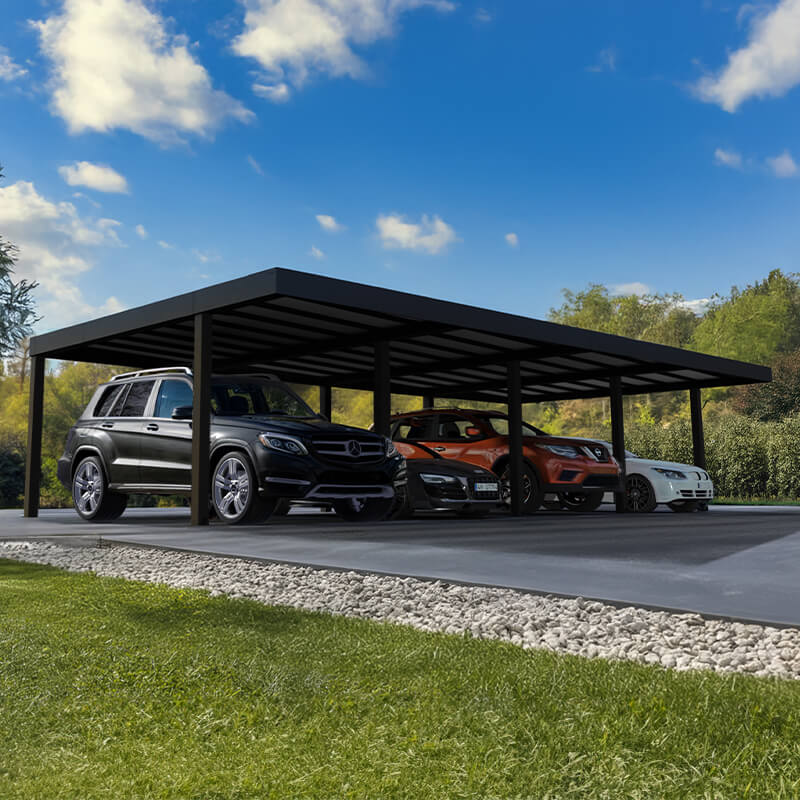
- Single-bay extended carports with extra width or depth for a vehicle and side access
- Double carports that allow two cars to sit side by side with a practical gap between them
- Tandem layouts for two vehicles parked front to back, useful where the driveway is long but narrow
- Corner or L-shaped arrangements for plots where a straight rectangle would waste space
- Open-sided canopy formats where access is the main aim and enclosure is not needed
The shape matters because a 70 m² footprint can be used in different ways. A wide format suits side-by-side parking, while a deeper form can work better for a van, boat trailer or mixed-use area. If your plot is awkwardly shaped, it is often worth thinking about turning space as much as the covered footprint itself. A carport that technically fits but feels tight at the entrance can become annoying very quickly.
Flat Roof, Pitched Roof, Curved Roof: The Big Difference
Roof style changes both the look and the feel of a carport. It is not only about appearance. It affects the way the structure reads against the house, the available headroom, and the impression of scale.
Flat roof carports have a clean, low-profile look. They are often chosen when the buyer wants the structure to stay visually quiet. In a large 800 sq ft layout, a flat roof can help stop the carport from dominating the garden or driveway. It tends to suit modern homes and straight-edged plots.
Pitched roof carports feel more traditional and give a stronger architectural presence. The roof line can make a sizeable structure feel more balanced, especially if it needs to sit near a house with a sloped roof. The pitched form also helps the carport look less like a shelter added at the last minute and more like part of the property plan.
Curved or arched roofs create a softer profile. They can work well where you want the carport to feel less rigid and more open. In larger sizes, the curve can break up the visual mass, which is useful when you are covering a broad area and do not want the frame to feel too industrial.
Each style has a different impact on headroom and visual weight. A pitched roof may feel more generous above the centre line, while a flat roof keeps the overall height lower. Curved forms sit somewhere between the two, often giving a lighter impression. Choosing the right one is partly practical, partly about the way the structure will sit in your everyday view.
Open Sides, Partial Panels, Full Shelter: Picking the Right Level
One of the main differences between carport types is how enclosed they are. That choice affects airflow, visibility and the degree of shelter around the vehicle.
Open-sided carports are the simplest and often the most flexible. They allow easy drive-in access and feel less restrictive. In a large footprint, open sides can stop the structure from feeling heavy, especially if it is covering more than one vehicle.
Partially enclosed carports can add side panels on one or more sides, which is useful if your site is exposed to wind or if you want some extra screening from neighbouring plots. This can also make the structure feel more defined without turning it into a full garage.
Fully sheltered carport designs with more enclosure sit between a garage and an open canopy. They are not the same as a garage, but they can give a stronger sense of boundary and make the space feel more deliberate. For buyers who want the carport to serve more than one purpose, partial enclosure can help create zones within the footprint.
The key difference is how much openness you want to keep. If the carport is mainly for quick daily parking, open sides are often enough. If it sits in a more exposed setting or needs to support mixed use, a more sheltered layout may be worth considering.
What 70 m² Can Actually Do
It helps to think in practical terms. A carport of around 800 sq ft / 70 m² gives you more than a single parking bay. It opens the door to layouts that can handle both vehicles and useful extra space.
- Two cars side by side with room to open doors more comfortably
- One vehicle plus storage for bikes, bins, garden tools or seasonal items
- Car and trailer parking in one covered zone
- Van parking where height and length are part of the brief
- Mixed-use shelter for parking on one side and loading space on the other
That versatility is a real selling point. A smaller carport may force you to choose between a parked vehicle and practical access. With a larger footprint, the structure can work harder without feeling crowded. This matters if you have more than one driver in the household, or if the carport needs to support different vehicles across the week.
Materials That Change the Feel
Material choice has a big effect on how a carport looks and how it sits against the property. In this size range, the structure needs to feel sturdy, but not bulky.
Timber carports have a warmer, more natural presence. They often suit rural plots, traditional houses or gardens where you want the structure to blend into the setting. Timber can soften the scale of a large 70 m² carport, especially if the frame is visible from the house or driveway.
Metal carports, often with steel or aluminium frames, tend to feel more architectural and direct. They suit modern plots and can suit a more minimal visual language. In a larger footprint, metal can keep the design looking crisp rather than overbuilt.
Polycarbonate roof panels are another common feature in carports, especially where light transmission matters. They let daylight into the covered area, which can be useful if the space doubles as a loading zone or if you simply do not want the area to feel too dark underneath. Opaque roofing gives more shade and a more enclosed impression, so the difference is worth noting.
For buyers, the choice often comes down to what they want the carport to say about the property. Timber feels more settled and domestic. Metal feels sharper and more functional. Both can work well, but they give a different character to a large shelter.
Why a Bigger Carport Changes Everyday Use
A compact carport provides cover. A larger one changes the way the whole driveway works. With 70 m², the space can support easier circulation, less reversing stress, and better use of the area around the vehicle.
The most obvious benefit is door clearance. In a tight bay, drivers and passengers often have to edge out carefully. A broader carport reduces that pressure. That is useful if you regularly carry shopping, children, sports kit or awkward items that need a bit of room.
A larger carport can also make the entrance feel calmer. The car is less likely to sit awkwardly against posts or walls, and the covered area can feel more open when you pull in. That may sound like a small thing, but over time it matters. The less you have to thread the car into a tight shelter, the more natural the whole routine feels.
There is also a visual benefit. A well-proportioned 800 sq ft carport can define the driveway without overfilling it. It adds structure to the front of the property and can make an otherwise open area feel more intentional. That can be a nice detail if you want the place to look tidy and organised, but not overworked.
How to Match the Carport to the Site
Fit is more than dimensions on paper. A carport of this size needs to work with the access route, the slope, and the way vehicles enter and leave the drive.
Driveway width matters because a large carport can feel awkward if the approach is too narrow. You want enough space to align comfortably before entering the shelter. If the opening is tight, a wide carport can still be usable, but the approach may need more care than expected.
Ground shape also matters. A rectangular footprint is straightforward, but not every plot is rectangular. On a wider plot, a side-by-side layout may be ideal. On a deeper plot, a tandem layout can make better use of the space. If the access angle is off, a more open-sided arrangement may make manoeuvring easier.
Roof overhang can affect perceived size. Some carports feel larger than their footprint because of the roof projection, while others stay visually compact. That difference can help when you want the shelter to look lighter from the street.
Little Details Buyers Notice Straight Away
When people compare carports, it is often the smaller design details that decide whether a structure feels right.
- Post placement and whether they interrupt door opening
- Clear height for SUVs, vans or roof boxes
- Roof pitch and whether it suits the house
- Span and width for easier parking without constant adjustment
- Side openness for visibility and access
- Visual weight on the plot, especially in front-garden positions
These points matter because the best carport is not just the one that fits the numbers. It is the one you can use without thinking about it every day. A large structure should make parking feel more relaxed, not more technical. If posts land in the wrong place or the height feels marginal, the whole setup loses its ease.
When a Carport Beats a Garage
For some buyers, the decision is not carport versus no cover. It is carport versus garage. In that comparison, the carport often wins on openness, quicker access and a less enclosed feel.
A 70 m² carport gives a broad sheltered area without the sense of shutting the vehicle away. That can be especially appealing if you use the car often and want something that feels immediate rather than enclosed. There is no need to open a full door, and no sense of parking inside a separate room.
It can also feel more adaptable. The same footprint that holds two cars may later work differently if your needs change. That flexibility is useful in a large format, because you are not locked into a single very narrow purpose. One season it may be a parking shelter, another time a storage-and-parking mix. That kind of room is hard to ignore.
Questions Worth Asking Before You Choose
Before buying, it helps to check the practical shape of the purchase, not just the headline size.
- Will the carport be used for one large vehicle or more than one vehicle?
- Do you need side clearance for doors, bikes or trolleys?
- Is the plot better suited to a wide or deep layout?
- Would an open-sided design feel right, or do you need more shelter?
- Does the roof style need to match the house, or simply sit quietly beside it?
- Will the shelter need to allow for a van, trailer or roof box?
These questions make it easier to separate the visually appealing options from the genuinely useful ones. A carport this size is a proper feature, so the best choice is usually the one that fits your vehicles, your access and your daily habits without forcing compromises.
A Practical Choice with Presence
A carport in the 800 sq ft / 70 m² range brings together scale and usability in a way that smaller shelters cannot always manage. It can cover more than one vehicle, ease day-to-day parking, and give the plot a more organised look without closing it off. The main differences come down to roof style, openness, material and layout, and each one changes how the carport feels in use.
If you want a structure that does not overcomplicate parking but still offers a clear step up from a basic canopy, this category is worth a close look. The best part is that the space is not wasted on looks alone. It serves a purpose, and when it is chosen well, it does so without making a fuss about it.
- Large covered area for vehicles, trailers or mixed use
- Open access compared with a closed garage
- Flexible layouts for wide or deep plots
- Different roof forms to suit modern or traditional properties
- Room to manoeuvre and less day-to-day parking stress
For buyers comparing options, a carport of this size can feel like a sensible middle ground: not too enclosed, not too small, and with enough presence to make the driveway work properly. That balance is often what people are really after, even if they do not say it out loud.
[Sassy_Social_Share]